The sun rises above a pale gold landscape. Fog lifts from the horizon, and dark fence posts stand against distant shapes. You can save those few seconds as a video. In Western Art’s Gold Fog series, the moving image begins as a scene drawn by JavaScript, with rules for the shapes, their depth and the changing light.
Western Art is an AI-and-JavaScript project by Joseph Charles Epstein, known as Prince Zoho. In Gold Fog, JavaScript draws the landscape on a canvas. The shapes, fog and light are calculated again as the scene moves.
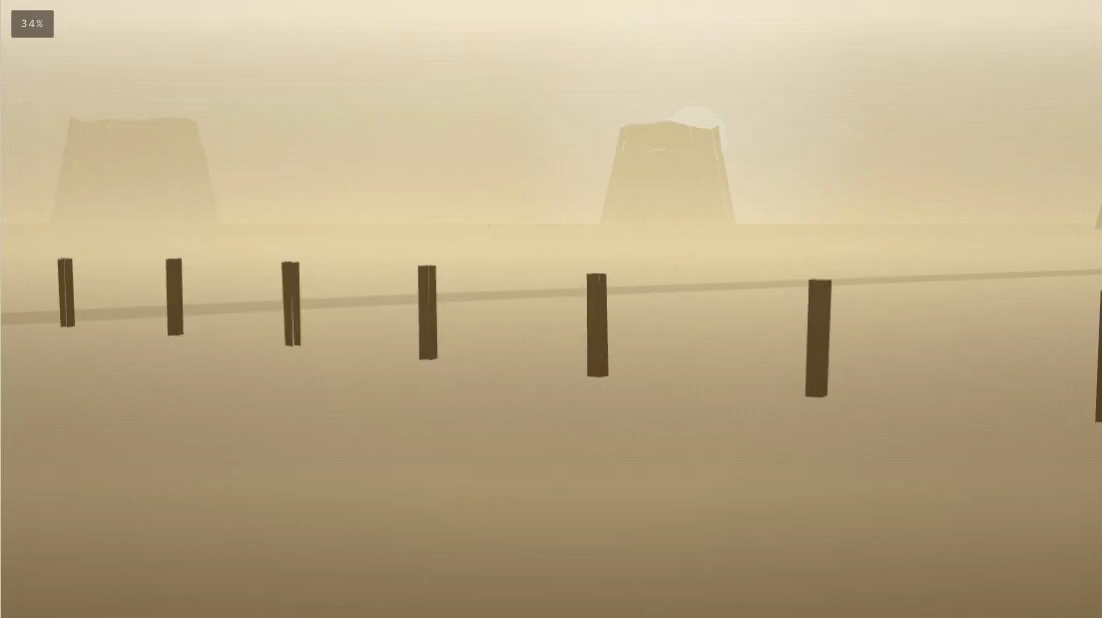
The drawing starts with a sky that changes from one color at the top to another near the horizon. The sun is a circle with a soft halo. The ground has its own gradient, pale in the distance and darker toward the viewer. These are separate drawing operations, so changing the sun’s height does not require replacing a finished background image.
The scene’s visible surfaces are grouped into six distance bands. Each band receives a shade from the gold palette, from pale far away to dark nearby. After drawing a band, the renderer lays a translucent sheet of fog over it. It repeats that process toward the foreground. Farther shapes can therefore sit behind more fog than nearer ones.
The order matters. A single pale overlay across the finished picture would wash over the fence posts and the distant formations together. Placing fog between depth bands lets the foreground remain legible while the horizon almost disappears. The early frame shows that relationship clearly: the posts are dark enough to count, while the distant shapes nearly share the sky’s color.
As the turn advances, one control value reduces the fog’s opacity and moves the sun upward. The camera also takes a small step forward. Those changes are connected in the renderer, so the dawn has a defined progression. The code reuses the constructed place and redraws it under the changing conditions.
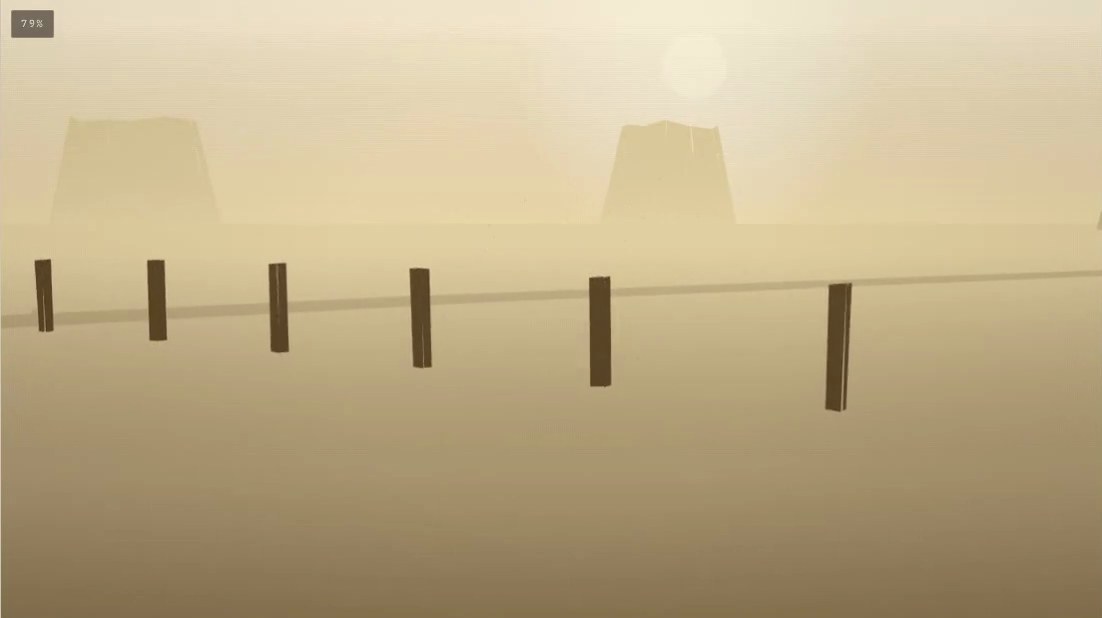
There is another, smaller kind of movement around the edges. The renderer alternates between two slight offsets for silhouette edges and fog placement. That gives the drawing a restrained flicker while the larger dawn movement continues. A gold palette and flat shapes do not mean the whole picture is a static painting being slid across the screen.
The useful difference from a delivered AI-generated video is what remains available to change. This landscape retains a description of the scene and instructions for drawing it. Its fog, sun and camera have separate values in that description. A saved video, whether captured from this canvas or exported from an AI video tool, gives the player a fixed sequence of pictures. It does not carry this landscape’s controls for recalculating the fog or moving its sun.
Scrubbing the recorded clip chooses another moment that was already saved. Running the landscape asks the renderer to draw a state of the scene. Both can look similar in a browser window, and both can have a play button. The appearance of the playback alone does not establish how the pictures were made.
The recorded Gold Fog excerpt is a silent, 7.5-second clip. It is useful for seeing the movement without running the scene, but its recording begins after the turn has started. To inspect the work itself, open The Gold Fog series and use the controls beneath a plate. The Western Art portfolio page keeps the landscape alongside the broader project.