TL;DR
- Halfsies scores a cut as the lighter half divided by the heavier half, times 100.
- On a 2 inch tall cake, a layer cut 1/8 inch off center scores about 78. The same 1/8 inch slip across an 8 inch width scores about 94.
- The shorter the side you are halving, the more a small slip costs, because the slip is a bigger share of the whole.
- The Halfsies cake guide's fix is to measure and mark the halfway height with toothpicks instead of trusting the eye.
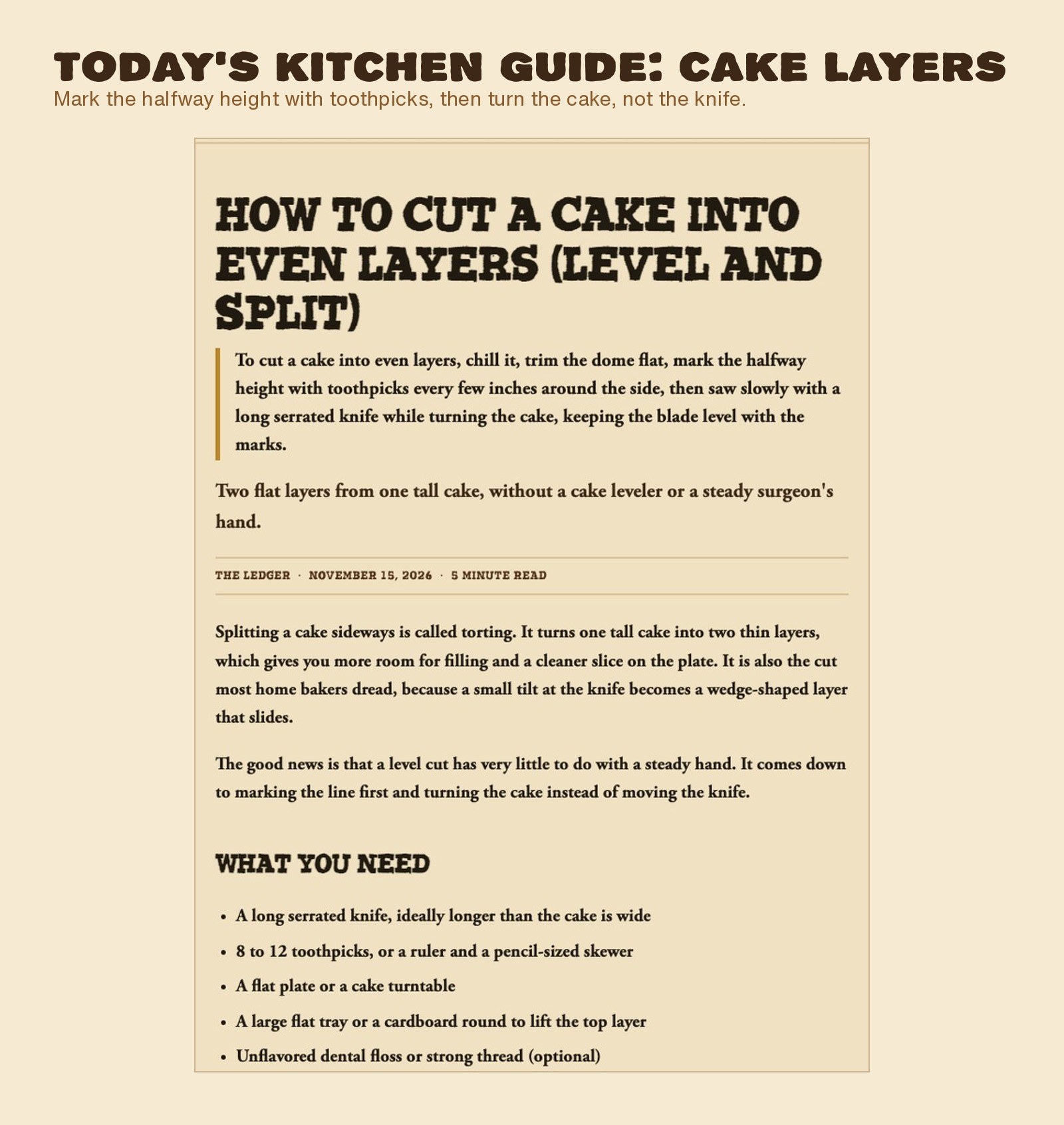
Halfsies is my daily cutting game. You get three hand-drawn objects a day and draw one cut across each, a scale weighs the two pieces, and each cut scores the lighter half divided by the heavier half, times 100. Today the game's guides page, The Ledger, explained how to split a cake into two even layers. One line in it is a good question for anyone who cuts things for a living: a cake 2 inches tall and 8 inches across is a hard shape to read.
The same slip, two directions
Take a cake that is 2 inches tall and 8 inches across, and treat it as a simple slab so the arithmetic stays honest. Split it into layers and miss the middle by 1/8 inch. One layer is 1 1/8 inches and the other is 7/8. Run that through the Halfsies rule and you get 0.875 divided by 1.125, about 78.
Now cut the same slab down the middle the long way and miss by the same 1/8 inch. The pieces are 4 1/8 and 3 7/8 inches wide. That scores 3.875 divided by 4.125, about 94.
| Cut | Side being halved | Pieces | Score |
|---|---|---|---|
| Layer cut | 2 inches | 1 1/8 and 7/8 in | about 78 |
| Cut across the width | 8 inches | 4 1/8 and 3 7/8 in | about 94 |
| Layer cut, 1/16 inch slip | 2 inches | 1 1/16 and 15/16 in | about 88 |
Same hand, same knife, same error. The layer cut loses 22 points and the long cut loses 6. A slip is measured against the length of the side you are halving, so on the short side it is a bigger share of the whole.
Why the eye does not save you
The guide says people tend to misjudge height against width, and that a short, wide object is a hard shape to find the vertical middle of. So the short side is where the eye is worst and where an error costs the most. That is a bad pairing.
The guide does not ask for a steadier hand. It measures half the height and pushes toothpicks in at that height every 2 to 3 inches around the side, 8 to 12 of them on an 8 inch cake. The blade rests on the ring and the cake turns. The eye is out of the job.
What this means in the game
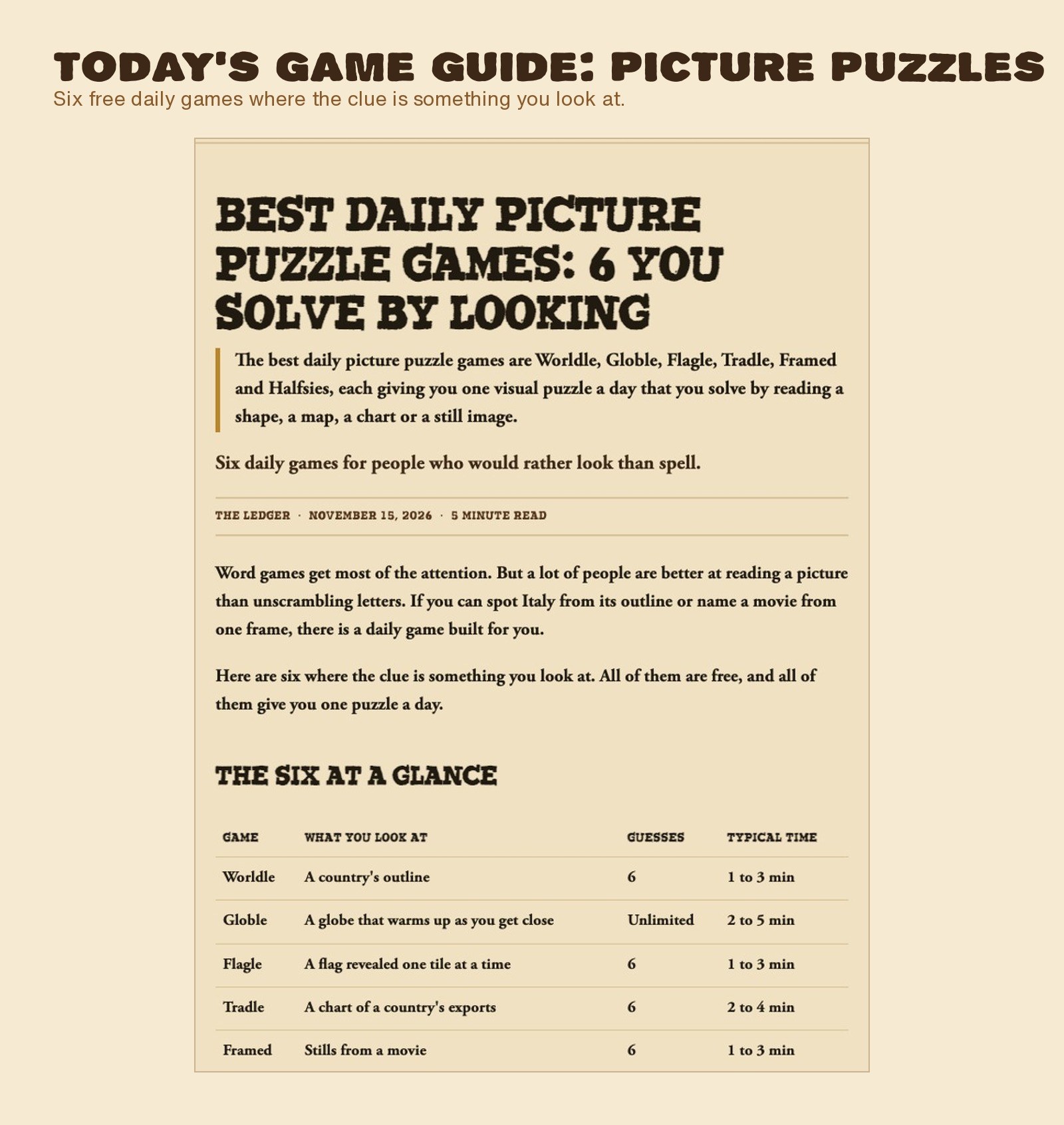
Halfsies weighs drawn area, so the same thing happens with hand-drawn objects. Today's other guide on The Ledger, a list of six daily picture puzzle games, puts it plainly: a long thin handle counts for very little and a wide round body counts for a lot. When the heavy part of an object is short in the direction you are cutting, a small miss is a big share of it, and the score drops fast.
There is no toothpick ring in the game. What you can do is the same thing the guide does: decide which side you are halving before you look for the middle, and give the short side more care than the long one.
The Halfsies ad diary #17 has the rest of the day, including the ad account, which spent nothing again. Diary #16 covers the turkey guide, which says a by-eye half is often 45% or 55%.
The cake guide is on The Ledger, and the game is at halfsies.jejestudios.com.